



In keeping with the theme of World Liver Day, I wanted to write a post centred around how the biological reality of chronic alcohol consumption conspires against us to ensnare you further into a cycle of drinking despite a desire to cut back. There are many Australians out there today doing significant damage to their livers despite having what they perceive to be an acceptable quantity of alcohol in their lives.
I am acutely aware of how much has been written on social media about the benefits of reducing one’s alcohol intake. Instead, I will take the approach of starting this article with a list of some of the main reasons why I see people turn to alcohol as a soothing mechanism, both in my private practice and my broader clinical work. Whilst I am not an addiction subspecialist, I see enough substance dependence across my work that I feel I can make some comments on the topic. I have worked with thousands of patients with addictions, and one of the privileges of being a psychiatrist is hearing their stories and being able to notice trends in society that are somewhat hidden because people dare not talk about them for the shame of judgement. Below are some of these trends I have observed.
Alcohol has been used to promote human connectedness and socialising since at least 10,000BCE. Our primate ancestors likely developed the capacity to metabolise alcohol at least 10 million years ago to make the best of the fermented fruit they found on the ground.
Many people out there seem to have almost no vulnerability to developing a problematic or harmful relationship with alcohol. Some of us however, have at the very least some internal struggle and ambivalence with our relationship to drinking – how else can one explain the explosion of content surrounding the alcohol-free lifestyle and its benefits. For some people, complete and total abstinence is the only way they can negotiate their relationship to substances whilst leading a healthy life. Many of my patients (religious or not) have found something that can only be described as salvation through Alcoholics/Narcotics Anonymous. Many people however can have a relationship with alcohol based upon a foundation of moderation.
Indeed, most of ancient Greek philosophy describes the blissfulness of moderation, whilst denouncing outright drunkenness. Many ancient philosophers also go on to describe how tedious they find those who promote and insist upon total abstinence, indicating how some things never change.
I have found that there seem to be three main kinds of people who land in front of a psychiatrist due to their drinking. Firstly, there are those with severe and complex histories of trauma. In most of these cases, the alcohol isn’t really the main issue at its root because these individuals are simply looking for anything to numb their psychological pain. For many, alcohol is simply the most socially acceptable substance to which they have access, and it provides an easy ticket to oblivion. Whilst addressing the drinking is an important first step, the real work is the trauma processing.
Secondly, there are those individuals with underlying anxiety disorders, often in the context of ADHD and or OCD. Alcohol is a particular vulnerability for them because they are in desperate search for a depressant to mute their internal raciness. Racing thoughts at night for those with ADHD, and ruminations in bed about the fleeting nature of life for those with OCD, appear to be particularly sensitive to the effects of a few drinks at night. Soon these individuals can’t fall asleep without it.
Thirdly, there are those individuals who need drinking to escape their particularly punitive superego structure. These are often people who had hypercritical parental figures or have set themselves up for failure with unrealistically high expectations of themselves. They constantly feel like they ‘should be better’ and ‘should be doing more.’ For these people the deep unconscious meaning of ‘should,’ ‘better,’ and ‘more’ are rich avenues of exploration through psychotherapeutic work. Often these people have a vulnerable narcissistic personality construct. For more information on fragile/vulnerable narcissism, I suggest you read the work of Heinz Kohut. This means that they enjoy drinking because it allows them to disappear into narcissistic fantasy. Blissful inebriation where they can imagine just how wonderful and powerful they might just be one day, because then they might be enough.
Regardless, the common thread woven between these distinct patient populations as to why they enjoy the state of intoxication is because it is the only way that their conscious experience can truly experience mindfulness, a state of pleasure experienced from simply ‘being.’
They are not ruminating about the past or worrying about the future, they are revelling in the joy of the now, experiencing ‘presence’ with what they perceive to be a startling clarity. This can obviously unravel quickly. And that really is the curse of alcohol – it works so well but for only a fleeting moment.
Sublime enjoyment of the state of being drunk soon becomes a total consumption with the thoughts of when you can have your next drink. The anxiety becomes palpable when you realise that it’s your last glass of wine from the bottle, or the final beer in the sixer. Then when you are sober, you are waiting for the next moment you can drink. Be it that night, or later in the week. You are subconsciously counting down the time - mindlessly wishing your time away so that you can be closer to drinking. This really becomes the opposite of mindfulness, and unfortunately there are many people out there just waiting for their next drink.
Aside from the clear health risks - from basically raising your risk of all cancers to contributing to fatal liver failure - alcohol is a terrible compound from a pharmacological perspective when it comes to alleviating anxiety. This is because you develop such rapid tolerance to it if ingested on consecutive days (tolerance meaning you need a higher quantity of a substance to achieve the same effects that you previously experienced with lower quantities). By day two of consecutive drinking, and certainly by day three, your brain is making adaptations to try and fight back against the sedating effects of alcohol. Once enough tolerance has occurred, you will inevitably develop biological dependence on a substance (biological dependence meaning that your body doesn’t like to function without a substance in its system, and that without this substance you will go into withdrawal).
Drinking alcohol leads to rapid tolerance. Tolerance leads to dependence. Dependence leads to withdrawal when you attempt to stop. Withdrawal symptoms are so unpleasant that it leads to drinking again to treat the withdrawal. And thus, the cycle begins. The neurobiological effects of this are driven by the complex relationship between two relatively ubiquitous neurotransmitters: GABA and Glutamate.
Gamma-aminobutyric acid (GABA) is the primary inhibitory neurotransmitter in the central nervous system, acting as the brain's main "brake" to reduce neuronal excitability and create a calming effect. By binding to GABA-A and GABA-B receptors, it slows down nerve signals, helping control anxiety, stress, fear, and promoting sleep. Whilst the pharmacodynamics of alcohol are complicated, many of its main pleasurable effects come from the fact that it so potently enhances the GABA neurotransmission system.
GABA is counterbalanced however by an excitatory neurotransmitter known as glutamate. These are yin and yang and both serve incredibly important functions. The body’s evolutionary homeostasis is desperate for both neurotransmitters to be in perfect sync. Glutamate is the major chemical messenger used to send "go" signals between nerve cells across extensive networks. Drinking alcohol regularly increases the amount of GABA neurotransmission which the body wishes to eventually fight against. By placing your body in a sedated and drowsy state for a prolonged period of time with regular drinking, the body’s evolutionary desire to be alert and aware of your surroundings starts to kick in. One of the main adaptations that occurs is that the brain starts producing more and more glutamate to counteract the GABA which is being boosted by the alcohol. This increase in glutamate is the reason why chronic alcoholics can drink such high quantities of alcohol without feeling sedated at all. The excitation from their brain’s own production of glutamate (their new ‘hyperglutamatergic state’) means that they can stay alert well after most other people are yawning at the dinner table and covertly checking if there is any surge on Uber. This process can go on indefinitely, and those of us working in the field have encountered people who can consume 40 standard drinks over the course of a working day without any significant impact on their level of alertness.
Unfortunately, this leads to an incredibly precarious position. Whilst the GABA and glutamate are in perfect balance for the heavy drinker, it is an artificial state of affairs because the GABA is coming from the alcohol, whilst the glutamate is coming from your brain. As soon as you stop drinking the GABA begins to rapidly diminish, whilst the glutamate keeps being produced in its very high quantities. This leads to the hyperglutamatergic state to which I previously referred. This is now the beginning of withdrawal.

Many of you have been through alcohol withdrawal on a mild to moderate scale without even knowing it. Racing heart rate, dry mouth, pressure behind the eyes, a wired state of anxiety with an inability to concentrate one’s attention, constant distraction and racing thoughts. This can progress to sweating and tremors. At its most extreme, hallucinations and seizures can occur. Death is even a possibility for the most severe cases.
The more mild symptoms of alcohol withdrawal driven by glutamate are likely familiar. Below is a graph of the timeline, which unfortunately creates a cycle that is very difficult to break. Mild symptoms of alcohol withdrawal begin 6-8 hours after the last drink. For heavier drinkers this can be 4 hours. I have seen someone start to withdraw within 2 hours of their last drink. Symptoms then peak between 24-48hours after the last drink, starting to crest and attenuate by the 72 hour mark.
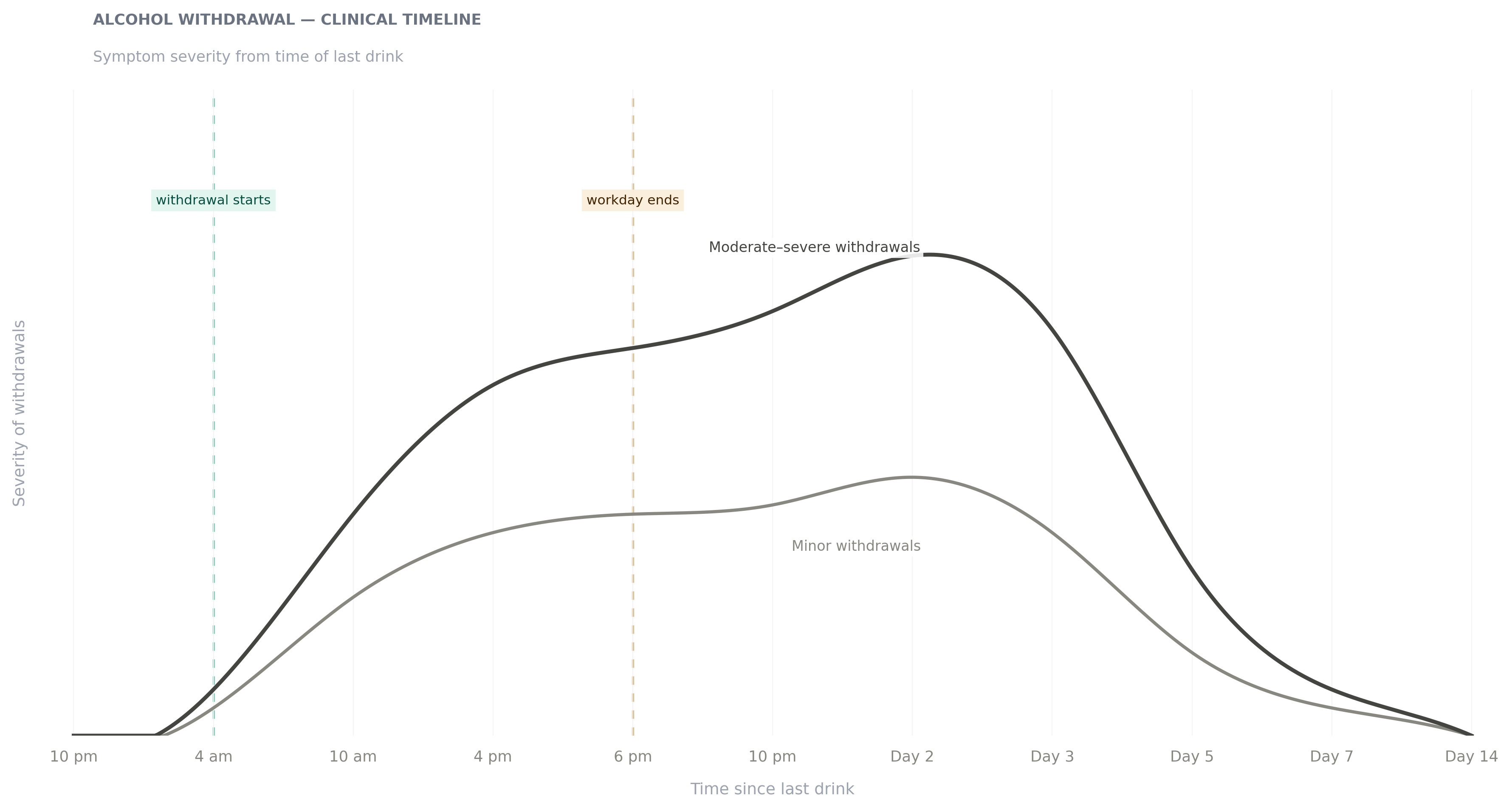
Chronic drinkers in Australia tend to fit into one of two categories. Type A chronic drinkers are those who drink half to one bottle of wine every night (or around a six pack of beer) and rarely take a night off drinking. They feel that this is a perfectly reasonable quantity to imbibe because they experience such little functional impairment. For these people, the story starts about 6 or so hours after the last drink. They suffer from terrible sleep which has deleterious knock-on effects to their entire state of mental and physical wellbeing. Their last drink is usually between 9pm and 10pm, which means the 6 hour mark for withdrawal onset is around 3am-4am. They awake with a racing heart, dry mouth, anxiety and racing thoughts about how they are going to face the oncoming day. Often, the very things that they are drinking to forget (trauma, how much stuff they haven’t gotten around to doing at work yet, their finances etc) are at their most intense during this time. If they have a spouse lying next to them sleeping then this is especially torturous as they are silently lying still whilst thinking these racing thoughts trying not to wake them. If they are lucky, they will be able to fall back asleep for an hour or so but many remain largely conscious until their alarm goes off a few hours later. They attend work in a state of heightened nervousness. Their distractibility and overall executive dysfunction means that they are in a state of survival for the day, only able to tackle the most pressing and urgent tasks. Their medium-term agenda and to-do list only fills them with dread and thus it goes completely untouched. Occasionally, a task on this list can be avoided no longer and it blows up in their face with a scolding from someone at work. They knew this was coming. The day progresses, and as seen from the graph, the withdrawal continues to intensify. The anxiety worsens and worsens, progressing into irritability and frank agitation. They arrive home approaching the 24 hour mark since their last drink. The withdrawal symptoms are now peaking. They have the option to continue not drinking, acknowledging that they will be faced with another night of anxiety and almost total insomnia, followed by an even worse day at work the following day. Or, they can put an end to it all right now and pour themselves a drink (‘just to have one or two with dinner’) and be granted what seems like a gift to be free from anxiety for the first time since that 3am wake up. The cycle continues.
Type B chronic drinkers spend Monday – Thursday without alcohol being a feature of their week and only then let loose on Friday (although with the WFH revolution, Thursday is the new Friday for these individuals). Starting on that first night of the weekend, they will drink heavily to the point of 10+ standard drinks and then continue on Saturday with a drink by the early afternoon at the latest to fix their hangover. This continues through Saturday night and then by Sunday the hangover is so severe that a few drinks for Sunday lunch is the only way to manage it. Their hangovers begin on Sunday night before a terrible sleep precedes their decidedly Blue Monday. Mondays are horrible enough that they can manage to convince themselves not to drink on Tuesdays and Wednesdays before starting it all back up again on Thursday (which is just as the 72 – 96 hours detox process has finished). Interestingly, this is the more damaging lifestyle from most studies into drinking habits. It is very frequently associated with stimulant misuse (namely cocaine and ‘ice’ in Australia) as the stimulants allow you to remain alert and conscious so that you can keep drinking. These people will occasionally go through bursts of drinking every night of the week and their lives will quickly become unmanageable, and they promptly return to the Monday – Thursday abstinence pattern to keep up appearances.
If you want to know the distillation (no pun intended) of most international guidelines into how to have a responsible relationship with alcohol, I have read through them all and attempted to summarise a few salient points:
- Firstly, no amount of alcohol is healthy. It is always a poison, but one that if consumed in low enough amounts probably won’t lead to too much damage. There are increasingly common sentiments that no health body (such as the WHO) should ever recommend alcohol as being safe.
- Secondly, every country has a different amount of alcohol in their standard drinks reference. In Australia, 1 of our standard drinks is 10g of pure ethanol. Confusingly, 1 standard drink in the UK (called 1 ‘unit’ over there) equals about 0.7 standard Australian drinks. Even more confusingly, 1 standard drink in the USA equals about 1.4 standard Australian drinks.
- To have the healthiest possible relationship with alcohol, never drink on consecutive days – ever. This will avoid the cycle of tolerance from having any chance of setting in. This unfortunately is at direct odds with our weekend drinking culture in Australia.
- Never drink more than 4 Australian standard drinks in one sitting.
- Never drink more than 10 Australian standard drinks in a week
- The maximum amount of safe drinking for those of you partial to a drink from a practical perspective would look like:
- splitting a bottle of wine with your partner on two non-consecutive nights per week (bottle of white on Thursday, and a bottle of red on Saturday).
- Up to 4 x 30mL shots of spirits, up to 42% strong.
- It could also look like 2 x pints of ~4.5% beer at the pub. If you drink a stronger beer then have a lighter one next – ideally the percentage strengths of both pints would add up to 9.0.
- If you drink out of cans then obviously you don’t need any help in figuring out how many standards you are consuming.
- Obviously less alcohol than this is preferred, but this is how far you can push it before you start risking an elevated risk of cancer and heart disease, and before you get into the territory of hangovers that are bad enough that they lead you to need to drink the next day.
- If you drink less than twice a week, then slowly and mindfully sipping your drink is the best thing you can do. Your tolerance will be low enough that you will be sensitive to very low quantities of alcohol. It has been my clinical experience that if you haven’t had a drink for over a week and you slowly sip a glass of wine, you will feel the effects within a quarter of a glass over roughly 10 minutes.
- Trying to finish your drinking at least 2 hours before you fall asleep does wonders for your sleep quality compared with falling asleep immediately after finishing your last drink.
Please note, if you haven’t had 72 hours without drinking for a while, then do not stop drinking cold turkey as you could be at risk of severe withdrawal symptoms. People can routinely feel like they can handle a day or two off without trouble, but its not until that third day without drinking that the most severe effects can rear their head. Please consult your GP if you would like to explore ways to curb your drinking, or indeed come and see me at Carlton Specialists.


